
Society Must Be Defended?
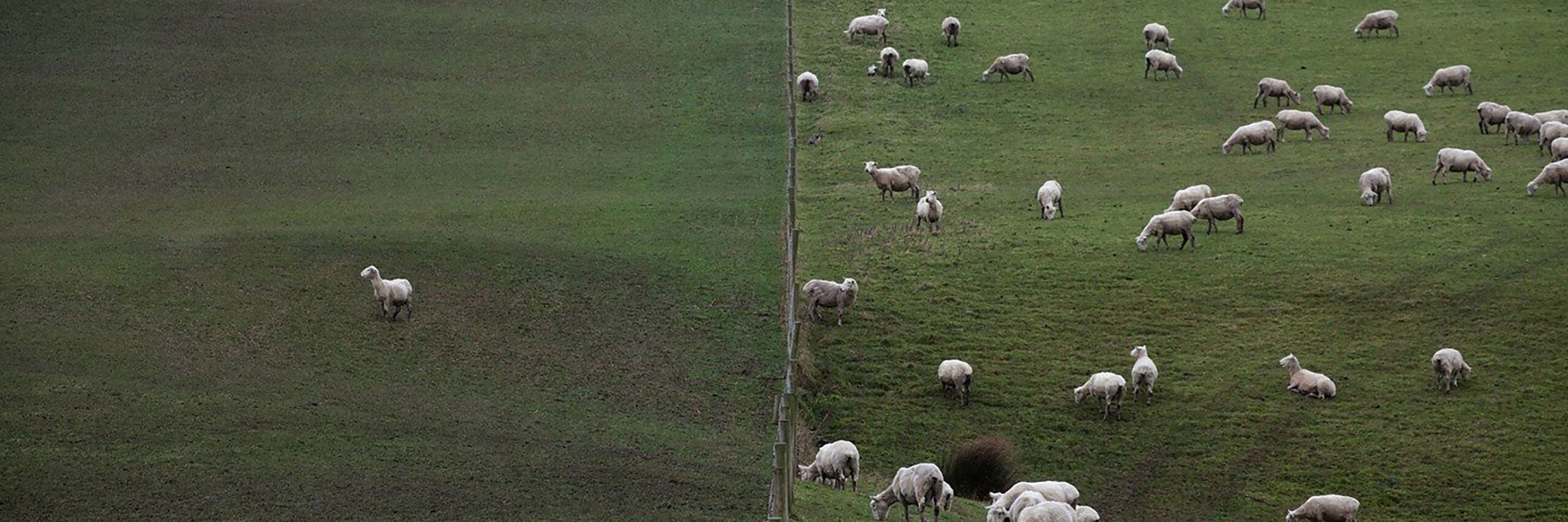
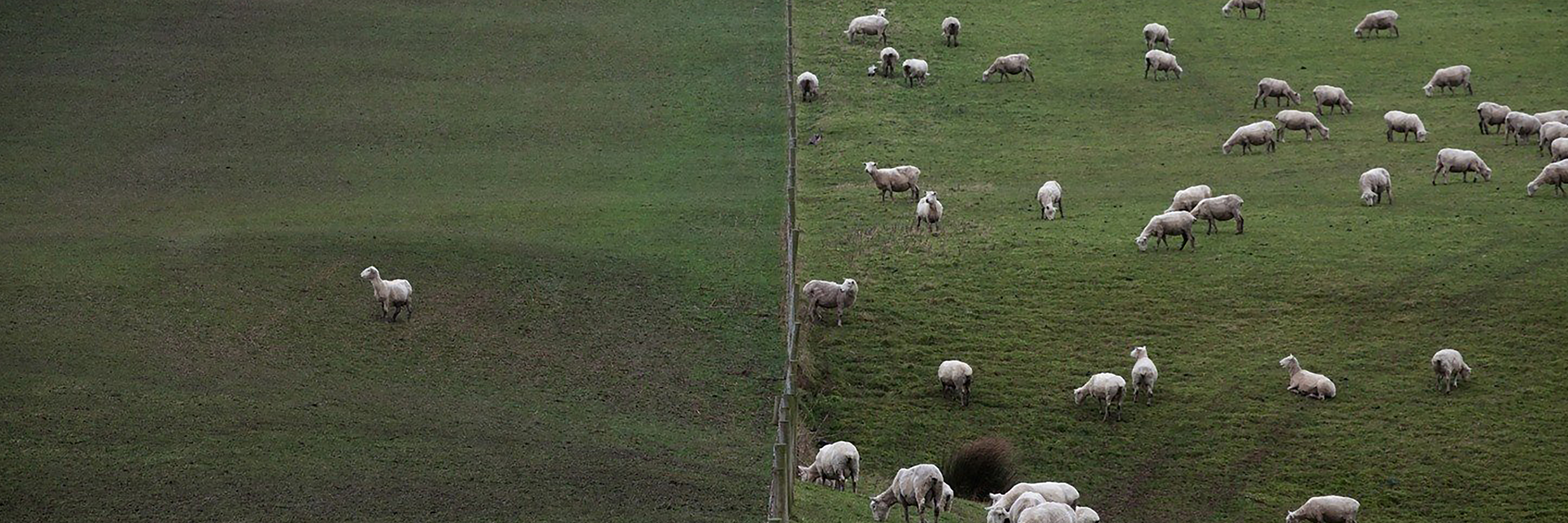
John-Paul Sartre, one of the great names of existential philosophy, says: "Man is condemned to be free". In this article, I would like to examine the relationship between human freedom and society through an image I came across while surfing the Internet. As you can see above, on one side of the fence there is a sheep (let us call it Sartre) that has "somehow" crossed the fence; and on the other side, there's a herd of sheep. When we look at the picture, the first thing that comes to our mind is that Sartre is now a free sheep, it crossed the fence that had limited it. But was Sartre truly free?
There is a book entitled '’The Social Construction of Reality'’ by Peter L. Berger and Thomas Luckmann. In the book, it is briefly stated that the reality is created by society as a result of the interaction of people with each other and it is transferred to the next generations. I was able to realize the true meaning described in this book after graduation. Especially when I was seeking employment, I was confronted with corruption in society for the first time. Educational life somehow alienated me from the society I lived in, from what Durkheim called "social realities". When “wrong” is acknowledged as “right” by society; a ''wrong' becomes truly ''right''. My experiences made me think of the «nature of reality». It was like a disenchantment for me to see that most of the things I had considered wrong were accepted as "correct" and that life flowed according to it. I don't know why I was so surprised by this since human beings believed for centuries that the earth was flat and lived in this way.
We had to watch a film called 'Swing Kids' in one of our PhD courses. One scene of the movie was quite striking. The story took place in the 1930s, when the Nazis began to have an impact on German society. In the film, we see young people's resistance to Nazi conformism who adore American music, British fashion and Harlem slang. In one of the main roles in the film, when an objection was raised against a Nazi soldier whom the mother of the main actor had met, by saying, "Mr Knopp is a nazi", his mother gave a very interesting and thought-provoking answer: "So what, the whole country is Nazi!" In a social context where everyone is a Nazi, where being a Nazi is a social norm and even not being a Nazi is costly, why would people take a stand against it? Is it possible to oppose this? Hannah Arendt in her book “The Banality of Evil” draws attention to the fact that Adolf Eichmann, who played an important role in the acts of the Nazis against the Jews and whom everyone considered as a monster, was actually an ordinary person and that an officer did evil deeds without thinking about his duty. What Arendt wanted to draw attention to was the society that created such individuals. In other words, wasn't German society guilty of the Holocaust?
Returning to the story of Sartre, the sheep; Human, as we know, is a social being, existentially dependent on other humans from birth to death. The meaning given to life only makes sense when other people are around. For this reason, when Sartre crosses the social boundaries, rules, traditions, that is what we can call the culture of the society in short, it will encounter a vast void. Here, there is a huge challenge in front of him now: giving meaning to life again. Interestingly, it can't do it alone; it requires the assistance of others. Sarter's freedom has no value in an equation where there is no society. An individual needs other people to direct his life. Society, on the other hand, arises from the individual's need to interact with other people, and over time it becomes a limiting factor. Strangely, society's limitation of the individual is the liberation of the individual at the same time. Therefore, we cannot talk about the freedom of Robinson Crusoe, who lives alone on an island. However, in a society that limits the individual in every sense, the individual cannot exist as an "individual". That's why, in today's world, the biggest struggle of the individual is to protect his autonomy against society.